
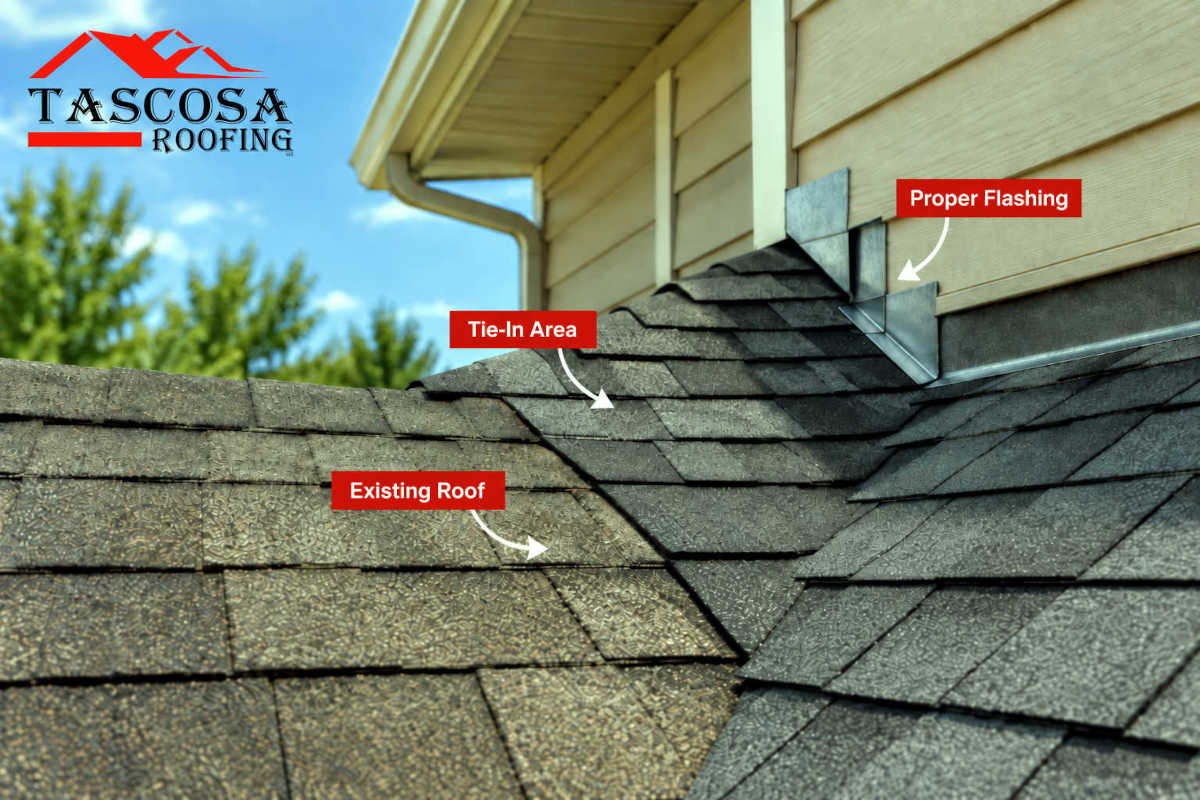
If you have ever wondered how to tie into existing roof shingles, you should know that tying into existing roof shingles is a roofing task that involves integrating new roofing materials with an existing shingle system so the finished area continues to shed water properly.
The work is not about building or modifying the roof structure. From a roofing standpoint, a tie-in focuses on the shingles, underlayment, flashing, valleys, roof-to-wall transitions, and the condition of the existing roofing materials.
When a tie-in is handled incorrectly, water can work its way beneath the shingles and lead to leaks, damaged decking, or repeated problems in the same area.
For homeowners in Amarillo and throughout the Texas Panhandle, proper roof tie-ins are especially important because strong winds, hail, and wind-driven rain can expose weak areas around flashing, valleys, and shingle transitions.
Here’s How to Tie Into Existing Roof Shingles Like Professional Roofers Do
Do You Tie Into Existing Roof Shingles?
To tie into existing roof shingles, a roofer typically removes or carefully lifts the shingles around the work area so the underlying roofing layers can be accessed.
New underlayment and flashing are then integrated with the existing roof, and the new shingles are blended into the surrounding shingle courses with the proper overlap, alignment, exposure, and fastening.
The exact process depends on where the tie-in is located and what type of roofing work is being performed.
A repair near a wall may require different flashing details than a repair in a valley, while a partial reroof may involve tying a larger section of new shingles into the remaining roof.
The goal is the same in every case: create one continuous roofing system that directs water down and off the roof instead of allowing it underneath the shingles.
What Does a Roofing Tie-In Include?
A roofing tie-in may involve several parts of the roof system, not just the visible shingles.
Depending on the project, the work may include:
- Removing or lifting existing shingles
- Inspecting the condition of the surrounding roofing
- Replacing damaged shingles
- Integrating new underlayment
- Installing or repairing flashing
- Waterproofing a roof valley
- Tying new shingles into existing shingle courses
- Checking shingle overlap and fastening
- Maintaining a clear path for water to drain off the roof
All of these components need to work together.
A roof can look finished from the outside while still having a problem underneath if the flashing or underlayment was not tied in correctly.
When Is a Shingle Tie-In Needed?
A tie-in may be needed anytime new roofing materials have to connect with existing shingles.
Roof Repairs
A damaged section of roofing may need to be opened so shingles, flashing, underlayment, or other roofing materials can be repaired or replaced.
Once the repair is complete, the new materials have to be tied back into the surrounding shingles.
Partial Roof Replacement
Sometimes damage is concentrated in one area and only part of the roofing system is being replaced.
The new shingles must be properly integrated with the portion of the roof that remains.
Storm Damage Repairs
Hail and high winds can damage shingles, flashing, and roof transitions.
Repairing those areas may require removing the damaged roofing materials and blending new shingles into the undamaged portion of the roof.
Existing Additions or Roof Sections
If another contractor has already completed an addition or roof structure, the roofing portion still has to be connected correctly to the existing shingle system.
Tascosa Roofing’s role is focused on the roofing materials and water protection, not the construction of the structure itself.
Roof Valleys
A valley is where two roof slopes meet and direct water toward the same channel.
Roofing work in these areas often requires careful integration of underlayment, flashing or membrane, and shingles.
Roof-to-Wall Transitions
Where shingles meet a vertical wall, proper flashing is critical.
The roofing materials need to direct water onto the roof surface rather than behind the siding or underneath the shingles.
Inspect the Existing Shingles Before Starting
The condition of the existing roof should be evaluated before new shingles are tied into it.
Important things to look for include:
- Cracked shingles
- Curling shingles
- Missing shingles
- Granule loss
- Brittleness
- Hail damage
- Wind damage
- Previous repairs
- Damaged flashing
- Signs of leaking
- Soft or damaged decking
This is especially important with older roofs.
As asphalt shingles age, they can become harder and more brittle. Lifting them during a repair may cause cracking or breakage.
If the surrounding shingles are already severely worn, tying a small section of new roofing into them may not provide the best long-term result.
In some cases, replacing a larger section of roofing may make more sense.
Remove or Lift the Existing Shingles Carefully
A proper tie-in usually requires access to the layers beneath the visible shingles.
That means some shingles may need to be removed or carefully lifted around the work area.
This gives the roofer access to the underlayment, flashing, and adjoining roofing materials.
Simply covering an existing connection with more shingles does not necessarily correct the underlying problem.
Care is particularly important when working with older roofing. Shingles that have spent years exposed to Texas sun, wind, and weather may crack when disturbed.
The goal is to open only the area necessary for the repair while avoiding unnecessary damage to the surrounding roof.
Integrate the Underlayment With the Existing Roof
Underlayment provides a secondary layer of protection beneath asphalt shingles.
When a roof repair or partial replacement ties into existing shingles, the new underlayment needs to overlap with the existing roofing system in a way that continues to shed water.
The basic principle is that upper roofing layers should overlap lower layers.
If water gets underneath the shingles, it should encounter another water-resistant layer that directs it downward instead of an open seam leading toward the roof deck.
This is particularly important around transitions where different sections of roofing meet.
Install or Repair the Proper Flashing
Flashing is one of the most important parts of many roofing tie-ins.
Its job is to direct water away from areas where shingles meet another surface or roofing feature.
Flashing may be needed around:
- Roof-to-wall intersections
- Sidewalls
- Headwalls
- Chimneys
- Valleys
- Roof penetrations
- Other roofing transitions
Step flashing is commonly used where a shingle roof meets a vertical sidewall.
Individual flashing pieces are integrated with the shingle courses so water is directed back onto the roof surface.
If flashing is missing, damaged, bent, or installed incorrectly, water may get beneath the shingles even when the visible roof appears to be in good condition.
Blend New Shingles Into the Existing Courses
Once the underlying roofing layers have been addressed, the new shingles can be blended into the existing roof.
Proper integration requires attention to:
- Shingle alignment
- Shingle exposure
- Course spacing
- Overlap
- Fastening
- Water flow
The new shingles should continue the same water-shedding pattern as the surrounding roof.
Water should move from the upper shingles onto the shingles below without encountering an exposed seam or reverse overlap.
The finished repair should function as part of the overall roofing system rather than as a separate patch sitting on top of it.
Can You Put New Shingles Over Existing Shingles at the Tie-In?
Simply placing new shingles over existing shingles is not always a proper roof tie-in.
If the issue involves underlayment, flashing, a valley, or a damaged roofing layer, covering the area may hide the problem without correcting it.
A proper repair may require shingles to be removed so the roofing system underneath can be inspected and repaired.
The right approach depends on:
- The location of the tie-in
- The condition of the surrounding shingles
- Existing flashing
- Underlayment condition
- The number of roofing layers
- The type of damage being repaired
The visible shingles are only one part of the system.
How Do You Tie Into Existing Shingles in a Roof Valley?
A roof valley deserves special attention because it carries water from two different roof slopes.
That means more water may flow through a valley than across nearby sections of the roof.
A valley repair or tie-in may involve:
- Removing shingles around the affected area
- Inspecting existing underlayment
- Installing additional waterproofing where appropriate
- Repairing or replacing valley flashing
- Replacing damaged shingles
- Maintaining the proper drainage path
- Keeping vulnerable fastening areas away from concentrated water flow
A poorly repaired valley can become a recurring source of leaks.
Because so much runoff moves through these areas during a storm, small roofing mistakes can create larger problems over time.
How Do You Tie Into Existing Shingles Against a Wall?
Where asphalt shingles meet a vertical wall, flashing is critical.
The roofing system needs to direct water onto the shingle surface rather than allowing it to get behind siding or underneath the roof.
Step flashing is commonly used along sidewalls, while different flashing details may be needed at other roof-to-wall transitions.
The shingles and flashing work together.
Even if the shingles themselves look good, incorrectly installed flashing can still allow water into the roofing system.
Should New Shingles Match the Existing Roof?
Whenever possible, new shingles should match the existing roofing in:
- Type
- Size
- Profile
- Thickness
- Color
Matching the physical characteristics helps the new shingles fit properly into the existing courses.
Color can be more difficult.
Older shingles may have faded or changed appearance after years of exposure to sun, wind, hail, and other weather.
Even when the same shingle product is still available, new shingles may look noticeably different when they are first installed.
That does not necessarily indicate a problem with the repair.
The new shingles may become less noticeable as they weather, although some color variation can remain.
Can You Tie Into Older Roof Shingles?
Yes, but older shingles can make the work more difficult.
As shingles age, they may become brittle and less flexible.
That can make it harder to lift them without cracking or damaging the surrounding roof.
A localized tie-in may not be the best option if the existing shingles are:
- Brittle
- Curled
- Cracked
- Losing large amounts of granules
- Frequently needing repairs
- Storm-damaged
- Near the end of their service life
In those situations, a larger roofing repair or replacement may provide better long-term protection.
A roof inspection can help determine whether the existing shingles are still suitable for a localized tie-in.
What Happens if a Roof Tie-In Is Done Incorrectly?
A poor tie-in can create problems that may not show up immediately.
Some issues only become obvious after repeated storms, strong winds, or periods of heavy rainfall.
Possible problems include:
- Water getting beneath the shingles
- Leaks around walls or valleys
- Loose or lifted shingles
- Damaged underlayment
- Flashing failure
- Repeated repairs in the same location
- Moisture damage to roof decking
- Interior water stains
The problem may also be difficult to diagnose if the visible shingles look normal.
That is why roofing tie-ins need to be evaluated as a complete system rather than judged only by appearance.
Signs an Existing Roof Tie-In May Be Failing
Roof tie-in problems do not always appear immediately.
Some develop gradually after repeated exposure to wind, rain, hail, and temperature changes.
Water Stains Inside the Home
Discoloration on ceilings or walls near a roofing transition may indicate water intrusion.
Loose or Lifted Shingles
High winds can expose poor fastening or weak shingle integration around a repair.
Damaged Flashing
Bent, loose, missing, or deteriorated flashing can allow water underneath the roofing materials.
Repeated Leaks in the Same Area
If the same section keeps leaking after multiple repairs, the actual problem may be with the original tie-in, flashing, or underlayment.
Problems Around a Valley
Cracked shingles, exposed fasteners, worn roofing materials, or damaged flashing around a valley can increase the chance of leaks.
Soft or Damaged Decking
Long-term moisture intrusion may eventually damage the decking beneath the roofing system.
Can a Bad Roof Tie-In Be Repaired?
In many cases, yes.
A roofing contractor may be able to perform a residential roof repair by opening the affected area and correcting the roofing details beneath the shingles.
The repair may include:
- Removing damaged shingles
- Opening the tie-in area
- Replacing damaged underlayment
- Correcting flashing
- Repairing a valley
- Replacing affected roofing materials
- Installing new shingles
- Blending the repair back into the existing roof
If the surrounding roofing remains in good condition, the repair may be limited to a relatively small area.
If the existing shingles are badly worn or damaged, a larger roofing project may provide a more reliable result.
Do You Need to Replace the Entire Roof to Fix a Bad Tie-In?
Not necessarily.
Some roof tie-in problems can be repaired locally.
A complete roof replacement may not be needed if:
- The surrounding shingles are still in good condition
- The problem is limited to a specific area
- The existing roof can be safely worked with
- The damage has not spread across a larger portion of the roof
A larger replacement may be worth considering if:
- The shingles are brittle or severely worn
- There is widespread hail damage
- Wind damage affects multiple roof areas
- Repairs have been needed repeatedly
- The surrounding roof is already approaching the end of its useful life
The condition of the entire roof should be considered before deciding how much roofing needs to be replaced.
Should a Roof Tie-In Be Inspected After Hail or High Winds?
Yes.
Roof tie-ins, valleys, flashing, and roofing transitions can be vulnerable during severe weather.
After a major storm, possible warning signs include:
- Missing shingles
- Lifted shingles
- Cracked shingles
- Hail impacts
- Damaged flashing
- Loose roofing materials
- Exposed fasteners
- New interior water stains
Some storm damage is difficult to identify from the ground.
A roof inspection can help determine whether the tie-in and surrounding roofing materials are still protecting the home properly.
Why Roof Tie-Ins Matter in Amarillo and the Texas Panhandle
Roofing systems in Amarillo and throughout the Texas Panhandle are regularly exposed to severe weather.
High winds can lift poorly secured shingles or push rain toward vulnerable roof transitions.
Hail can damage shingles and metal flashing.
Wind-driven rain can also expose problems that may not be noticeable during lighter rainfall.
Areas such as valleys, roof-to-wall transitions, partial repairs, and existing roof tie-ins deserve particular attention because multiple roofing components come together in these locations.
A properly completed tie-in helps those materials work as one roofing system.
What Should a Roofer Inspect Around a Shingle Tie-In?
A professional roofing inspection should look beyond the appearance of the shingles.
The roofer may evaluate:
- Shingle condition
- Shingle overlap
- Alignment
- Fastening
- Existing flashing
- Underlayment
- Roof valleys
- Previous repairs
- Water flow
- Hail damage
- Wind damage
- Interior water stains
- Signs of damaged decking
Finding the actual cause of a roofing problem is important.
Replacing a few shingles may not solve a leak if damaged flashing or improperly integrated underlayment is the real source.
When Should You Call a Roofer About a Shingle Tie-In?
Consider having the area inspected if you notice:
- A leak near a roofing transition
- Repeated leaking in the same location
- Lifted or loose shingles
- Damaged flashing
- Problems around a roof valley
- Signs of hail damage
- Signs of wind damage
- Interior water stains
- A repair that does not appear to blend properly with the existing roof
It can also be helpful to evaluate the condition of an older roof before new roofing materials are tied into the existing shingles.
That inspection can help determine whether a localized repair is practical or whether the surrounding roofing needs additional attention.
Can You Tie Into Existing Roof Shingles Yourself?
Some minor shingle repairs may be manageable for experienced homeowners, but a true roofing tie-in can involve more than replacing a few visible shingles.
The work may require access to the underlayment, flashing, valleys, and surrounding roof system.
There is also the safety risk that comes with working at height.
More importantly, a mistake can create a hidden water path that may not become noticeable until damage has already occurred.
For larger repairs, valleys, roof-to-wall transitions, partial reroofing, or areas with existing leaks, professional roofing evaluation is generally the safer approach.
Need Help With an Existing Roof Shingle Tie-In?
A proper roof tie-in involves more than making new shingles look like they belong with the existing roof.
The shingles, flashing, underlayment, valleys, and surrounding roofing materials all need to work together to move water away from the home.
If you have a roof repair, partial replacement, storm-damaged area, valley, roof-to-wall transition, or an existing roof section that needs to be tied into surrounding shingles, Tascosa Roofing can inspect the roofing area and help determine the appropriate repair approach.
Tascosa Roofing provides residential roofing services in Amarillo and throughout the surrounding Texas Panhandle.
Call Tascosa Roofing at 806-454-9277 to schedule a roof inspection or discuss your roofing project. Alternatively, you can fill out our quick start form.
Frequently Asked Questions
How do you tie new shingles into existing shingles?
New shingles are typically tied into an existing roof by removing or carefully lifting the surrounding shingles, integrating new underlayment and flashing where necessary, and blending the new shingle courses into the existing roofing with the proper overlap, alignment, and water flow.
Do you have to remove shingles to tie into an existing roof?
In many cases, yes. Removing or lifting shingles gives the roofer access to the underlayment, flashing, and other roofing layers that may need to be integrated or repaired.
Can you tie into old roof shingles?
Yes, as long as the existing shingles are still in suitable condition. Older shingles that are brittle, cracked, curled, or heavily worn may be difficult to work with and can make a larger repair or roof replacement more practical.
Can you put new shingles over old shingles at a tie-in?
Simply placing shingles over an existing roofing connection does not necessarily create a proper tie-in. The underlayment, flashing, and surrounding roofing materials may need to be accessed to create a reliable repair.
How do you waterproof where two roofing sections meet?
The correct method depends on the location of the connection. Valleys may require additional underlayment, waterproof membrane, or valley flashing, while roof-to-wall areas commonly use step flashing or other flashing details. All of the roofing layers should work together to direct water away from the roof.
Why does a roof leak around a tie-in?
A tie-in may leak because of damaged flashing, poor shingle overlap, improperly integrated underlayment, valley problems, exposed fasteners, storm damage, or deteriorated roofing materials.
Can a bad roof tie-in be repaired without replacing the whole roof?
Often, yes. If the surrounding roof is still in good condition, the affected area may be opened, repaired, and tied back into the existing shingles. A larger replacement may be appropriate if the surrounding roofing is already badly worn or damaged.
Should a roof tie-in be inspected after hail or high winds?
Yes. Hail and strong winds can damage shingles, flashing, valleys, and roofing transitions. An inspection can help identify problems that may not be obvious from the ground.
What if the new shingles do not match the existing roof?
Even if the same shingle product is available, older shingles may have changed color after years of weather exposure. New shingles can often be matched closely in type and profile, but some color variation may remain.
Is a roof tie-in the same as roof construction?
No. A roofing tie-in focuses on integrating roofing materials such as shingles, underlayment, and flashing with an existing roof. Structural construction, framing, or building an addition is separate from the roofing work itself.