
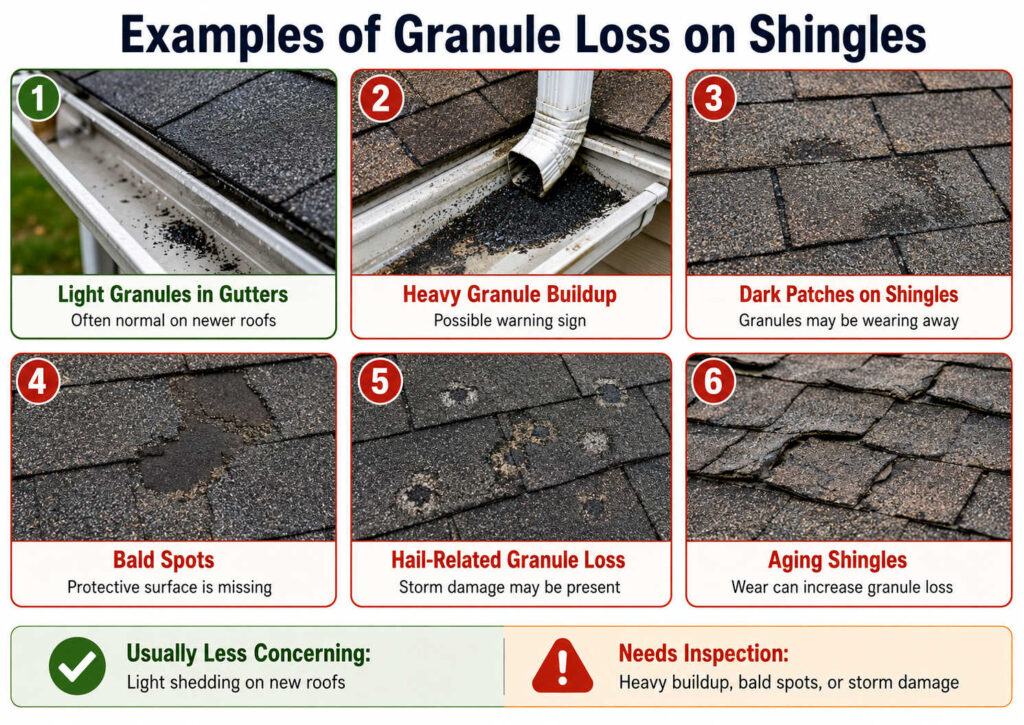
After a storm, you check the gutters and notice a gritty, sand-like material near the downspouts. Or maybe you spot dark patches on your roof where the shingles used to look more even in color. At first, it may not seem like a major concern. Your roof is still intact. There are no visible leaks, and all the shingles appear to be in place.
Those small particles might be shingle granules, and they play an important role in protecting your roof.
Granule loss on shingles can be normal, especially on a new roof. However, excessive granule loss can point to underlying issues, especially when it happens often or appears in large amounts. Your shingles may be aging or damaged by storms, leaving your roof more vulnerable to sun, rain, wind, and hail.
Homeowners in Amarillo and the Texas Panhandle need to know the difference between normal granule shedding and serious roof damage. Regional roofs face tough conditions, including strong sun, high winds, hail, and sudden weather changes. Knowing what to look for can help you catch problems early and avoid bigger roofing issues later.
Is Granule Loss on Shingles Normal?
Granule loss on shingles is common in some situations, including:
- When the roof is new
- After light weather exposure
- When only a small number of granules appears in the gutters
However, granules piling up in gutters can be a warning sign. Bald spots on shingles, dark patches on the roof, or granule loss that keeps happening after storms can also point to trouble.
In other words, the amount, timing, and pattern matter. A light sprinkle of granules is usually less concerning. Large piles washing out of your downspouts deserve a closer look.
What Are Shingle Granules and Why Do They Matter?
Manufacturers embed mineral granules into asphalt shingles during production. These granules add color and texture, but they also serve important protective functions. They shield the asphalt layer from sunlight, weather, and daily wear.
Granules serve several important purposes:
- They protect the asphalt layer from UV rays
- They help shingles resist weather exposure
- They provide color and texture
- They help slow roof aging
- They add durability to the shingle surface
Asphalt shingle granule loss can expose the underlying asphalt or fiberglass mat. This exposure may cause shingles to dry out, crack, curl, or break apart faster. When shingles fail, moisture can enter the roofing system and cause serious damage.
Over time, these issues can lead to expensive repairs or even a full roof replacement.
Are shingle granules only there for appearance?
No. Shingle granules add color and texture, but their main job is to protect the asphalt from sunlight, weather, and daily wear.
According to the Asphalt Roofing Manufacturers Association, granules help provide shingle color and protect the asphalt from sun-related degradation as part of the overall asphalt shingle roofing system.
Why Granule Loss on Shingles Happens
Not all granule loss means the roof is failing. Shingles can lose granules for several reasons, and some causes are more serious than others.
Common causes of shingle granule loss include:
- New roof shedding
- Normal roof aging
- Hail impact
- High winds
- Heavy rain runoff
- Foot traffic on the roof
- Tree branch abrasion
- Poor attic ventilation or excess heat
- Low-quality or defective shingles
- Older shingles reaching the end of their service life
A new roof may shed some loose granules soon after installation. Older shingles may lose granules as they age. Severe weather can also play a role. Hail, wind, and flying debris can strip granules from the shingle surface.
Homeowners should look at the full condition of the roof instead of judging the problem based on minor granule loss alone.
When Granule Loss Is Usually Normal
A little granule loss on shingles does not mean you need a new roof. In many cases, minor shedding is part of the normal life of an asphalt shingle roof.
Manufacturer guidance on excess roofing granules on shingles explains that some loose granules can be normal, while exposed bare spots are more concerning.
Granule loss is usually normal when:
- The roof was recently installed
- A small amount appears after the first few rains
- Loose, extra granules wash off the shingle surface
- Granules appear lightly during gutter cleaning
- The roof color still appears uniform from the ground
- There are no bald spots, cracks, leaks, or missing shingles
New asphalt shingles often have extra loose granules from manufacturing and installation. After rain, wind, or normal runoff, those particles may wash into the gutters. If the amount is light and does not stay high over time, it may not be a major concern.
Do new shingles lose granules?
Yes. New shingles may lose granules shortly after installation. Light shedding is usually normal, especially after rain or wind.
What It Means When You Find Shingle Granules in Gutter Areas
Homeowners often first notice granule loss when they see shingle granules in the gutters. Gutters catch water from the roof, but they also collect loose debris that washes off the shingles. This can include dirt, leaves, small branches, and roof granules.
A small amount of shingle granules in gutter areas can be normal, especially after a new roof installation or heavy rain. However, heavy buildup is different. If you repeatedly see piles of granules in gutters, around downspouts, or near splash blocks, your shingles may be losing more of their protective surface than they should.
Granules in gutters can be more concerning when they appear with other signs, such as:
- Bald spots on shingles
- Dark patches on the roof
- Cracked or curling shingles
- Missing shingles after wind
- Dented gutters, vents, or flashing after hail
- Water stains inside the home
If you notice granules in your gutters after storms, it may be time to schedule a roof inspection with Tascosa Roofing LLC.
Should I worry about shingle granules in gutter areas?
A small amount of shingle granules in gutter areas can be normal. Heavy, repeated buildup may be a warning sign that the shingles are losing their protective surface.
Normal Granule Loss vs. Warning Sign: Quick Comparison
| What You Notice | Usually Normal | Possible Warning Sign |
|---|---|---|
| Light granules after a new roof installation | Yes | Not usually |
| A small amount of granules after rain | Sometimes | If it happens repeatedly |
| Granules in gutters after a hailstorm | Sometimes | Yes, especially with other damage |
| Heavy piles of granules near downspouts | No | Yes |
| Bald spots on shingles | No | Yes |
| Dark patches on the roof | No | Yes |
| Shingles cracking, curling, or blistering | No | Yes |
| Interior ceiling stains or leaks | No | Yes |
| Granule loss on an older roof | Sometimes | May indicate advanced wear |
This comparison can help homeowners decide whether the issue is likely normal wear or something that deserves a professional inspection.
Warning Signs Homeowners Should Not Ignore
Granule loss becomes more serious when it is heavy, repeated, or paired with visible roof damage. Since shingles rely on granules for protection, widespread loss can make the roof more vulnerable to sunlight, moisture, and further deterioration.
If granule loss appears with active leaks, ceiling stains, or missing shingles, homeowners may need emergency roof repair after a storm.
Warning signs to watch for include:
- Heavy granules collecting in gutters
- Granules washing out of downspouts
- Bald spots on shingles
- Dark or shiny patches on shingles
- Exposed asphalt showing through
- Cracked, curled, or brittle shingles
- Missing shingles after wind or hail
- Dented vents, flashing, or gutters after hail
- Roof leaks or ceiling stains
- Granule loss that gets worse after every storm
These signs may indicate that your roof is no longer fully protected. Even if there is no active leak, exposed or weakened shingles can allow problems to develop over time.
If these signs appear, homeowners should contact a professional roofing contractor such as Tascosa Roofing LLC for an inspection before the issue turns into a larger repair.
How much granule loss is too much?
Granule loss may be too much when it creates visible bald spots, causes repeated gutter buildup, or leaves shingles looking dark, patchy, or exposed.
Can Hail Cause Asphalt Shingle Granule Loss?
Yes, hail can cause asphalt shingle granule loss. When hail hits a roof, it can loosen or knock granules from the shingles. In some cases, hail damage is obvious. In other cases, the damage is subtle and difficult to see from the ground.
The NOAA National Severe Storms Laboratory explains that hail can damage structures and property, which is one reason Amarillo homeowners should take roof changes seriously after severe storms.
Hail-related granule loss may show up as:
- Dark spots on shingles
- Bruised-looking areas
- Exposed asphalt
- Granules collected in gutters
- Dented metal vents, flashing, or gutters
- Shingles that look uneven after a storm
In Amarillo and the Texas Panhandle, homeowners often worry about hail damage. A roof may look fine from the ground even when the shingles have impact damage. That is why a professional inspection is recommended after major hailstorms, especially if you notice granules in gutters or visible changes in the roof surface.
Can hail cause shingle granule loss?
Yes. Hail can loosen or remove granules from asphalt shingles, especially when impact marks are paired with dark spots, exposed asphalt, or granules collecting in gutters.
Because hail damage can be subtle, homeowners may also want to learn how to tell if your roof has hail damage after severe weather moves through the Texas Panhandle.
If a roof inspection confirms storm-related damage, Tascosa Roofing LLC can also help homeowners with roofing insurance claims assistance in Amarillo.
Granule Loss in Amarillo: Why Local Weather Matters
Roofs in Amarillo and the Texas Panhandle deal with tough conditions. High winds, hailstorms, intense sunlight, heavy rain, and fast temperature changes can all affect the life of asphalt shingles.
Local weather can make shingle granule loss more noticeable because storms often send loosened granules into gutters and downspouts. Wind can lift or stress shingles. Hail can impact the surface. Intense sun can speed up wear once the protective granule layer is compromised.
Understanding how Amarillo weather affects roofing can help homeowners recognize why hail, wind, sun, and fast temperature changes often make roof wear more noticeable.
Homeowners searching for signs of roof damage after a storm in Amarillo may first notice granules in gutters before they notice missing shingles or leaks. That does not always mean the roof is failing, but it does mean the roof should be watched carefully.
Tascosa Roofing LLC helps Amarillo-area homeowners evaluate whether shingle granule loss is normal wear, storm-related damage, or a sign that repair or replacement may be needed.
What to Do If You Notice Granules in Gutters
If you notice granules in gutters, do not panic. Start by looking for patterns and other signs of damage. A one-time, light amount may not be serious. Heavy or repeated buildup deserves more attention.
If you notice heavy or repeated granule buildup after storms, it may be time to schedule a roof inspection in Amarillo before small issues turn into larger roofing problems.
Here are practical steps homeowners can take:
- Check gutters and downspouts from the ground
- Look for repeated granule buildup after rain
- Take photos of granules, downspouts, and visible roof areas
- Look for dark patches, missing shingles, or exposed spots
- Check ceilings and attic areas for moisture signs
- Avoid walking on the roof
- Schedule a professional inspection if granule loss is heavy or repeated
It is also a good idea to make notes after major storms. If you notice more granules after hail, wind, or heavy rain, that information can help a roofing contractor understand when the issue may have started.
Should I climb on my roof to check granule loss?
No. Homeowners should inspect safely from the ground and leave close roof inspections to a professional roofing contractor.
Does Granule Loss Mean You Need a Roof Replacement?
Granule loss does not always mean you need a new roof. The right solution depends on the condition of the roof as a whole.
Minor, isolated shingle granule loss may only require monitoring or residential roof repair in Amarillo, while widespread granule loss may require a more detailed inspection.
A roofer will typically consider:
- The age of the roof
- The amount of granule loss
- Whether shingles have bald spots
- Whether storm damage is present
- Whether leaks or moisture issues exist
- The condition of flashing, vents, and surrounding roof materials
- Whether the damage is isolated or widespread
Minor, isolated shingle granule loss may only require monitoring or small repairs. Widespread granule loss, exposed asphalt, storm damage, or multiple roof issues may require more extensive repair or replacement.
This is why an inspection matters. It gives homeowners a clearer answer instead of guessing based on what they see in the gutters.
Quick Roof Granule Loss Inspection Checklist for Homeowners
Use this checklist after storms, during gutter cleaning, or whenever you notice changes in your roof.
- Granules collecting in gutters
- Granules washing out of downspouts
- Bald spots on shingles
- Dark patches on the roof
- Cracked, curled, or brittle shingles
- Missing shingles after wind
- Dented gutters, vents, or flashing after hail
- Ceiling stains or roof leaks
- Granule loss that continues after multiple rains
- Older roof showing uneven color or texture
If several of these signs are present, schedule a professional roof inspection with Tascosa Roofing LLC.
Frequently Asked Questions About Granule Loss on Shingles
Is granule loss on shingles normal?
Yes, a small amount of granule loss on shingles can be normal, especially on a new roof or after light weather exposure. Heavy or repeated granule loss may indicate aging shingles or storm damage.
What causes shingle granule loss?
Shingle granule loss can be caused by normal aging, new roof shedding, hail, wind, heavy rain, foot traffic, tree abrasion, poor ventilation, or older shingles reaching the end of their lifespan.
Should I worry about shingle granules in gutter areas?
A small amount of shingle granules in gutter areas is not always a concern. However, heavy buildup, repeated granule collection, or granules paired with bald spots may be a warning sign.
What do granules in gutters mean?
Granules in gutters usually mean that mineral granules have washed off the surface of asphalt shingles. This may be normal in small amounts, but excessive granules in gutters can indicate wear or storm damage.
Can hail cause asphalt shingle granule loss?
Yes. Hail can knock granules loose from asphalt shingles and may leave dark, bruised, or exposed areas. A roof inspection is recommended after severe hailstorms.
How much granule loss is too much?
Granule loss may be too much if it creates bald spots, exposes asphalt, collects heavily in gutters, or continues after multiple storms.
Does granule loss mean I need a new roof?
Not always. Minor granule loss may only need monitoring or small repairs. Widespread granule loss, exposed asphalt, leaks, or storm damage may mean the roof needs repair or replacement.
When should I call a roofer about granule loss?
Call a roofing contractor if you notice heavy granules in gutters, bald spots, leaks, missing shingles, storm damage, or repeated granule loss after rain.
Small Granule Loss May Be Normal, But Heavy Loss Should Be Checked
Granule loss on shingles is not always an emergency. A small amount of shedding can be normal, especially on a newer roof or after rain. However, heavy, repeated, or visible shingle granule loss should not be ignored.
Shingle granules protect asphalt shingles from sun, rain, wind, and weather exposure. Once too many granules are gone, the roof becomes more vulnerable to aging, cracking, leaks, and storm-related damage.
Homeowners in Amarillo and the Texas Panhandle often struggle to see roof wear from the ground. Local weather conditions can make that even harder. If you notice shingle granules in gutter areas, dark patches on your roof, or signs of storm damage, a professional inspection can help you understand what is really happening.
Tascosa Roofing LLC can inspect your roof and determine whether the problem is normal wear, storm damage, or a sign that roof repair may be needed.
Schedule a Professional Roof Inspection
If you have noticed granule loss on shingles, heavy granules in gutters, or possible storm damage after recent Amarillo weather, schedule a professional roof inspection with Tascosa Roofing LLC.
Call 806-583-1258 to schedule your roof inspection today. Acting early gives you peace of mind and helps protect your home before small roofing concerns turn into bigger problems.